You just finished a typing test and got 35 WPM. But is that a good score for your age, or are most people your age typing much faster?
The average typing speed by age can help you understand where you stand, but the numbers aren’t as straightforward as many online charts suggest.
Typing experience, accuracy, and practice can make a big difference, even among people of the same age.
In this article, we’ll explore research-backed typing speed statistics, WPM benchmarks for kids, teenagers, and adults, and how to determine whether your typing speed is good for your age.
What Is the Average Typing Speed by Age?
The average typing speed by age varies depending on keyboarding experience, practice, and education.
Younger children usually begin with lower typing speeds, while teenagers and adults often type faster as they become more familiar with the keyboard.
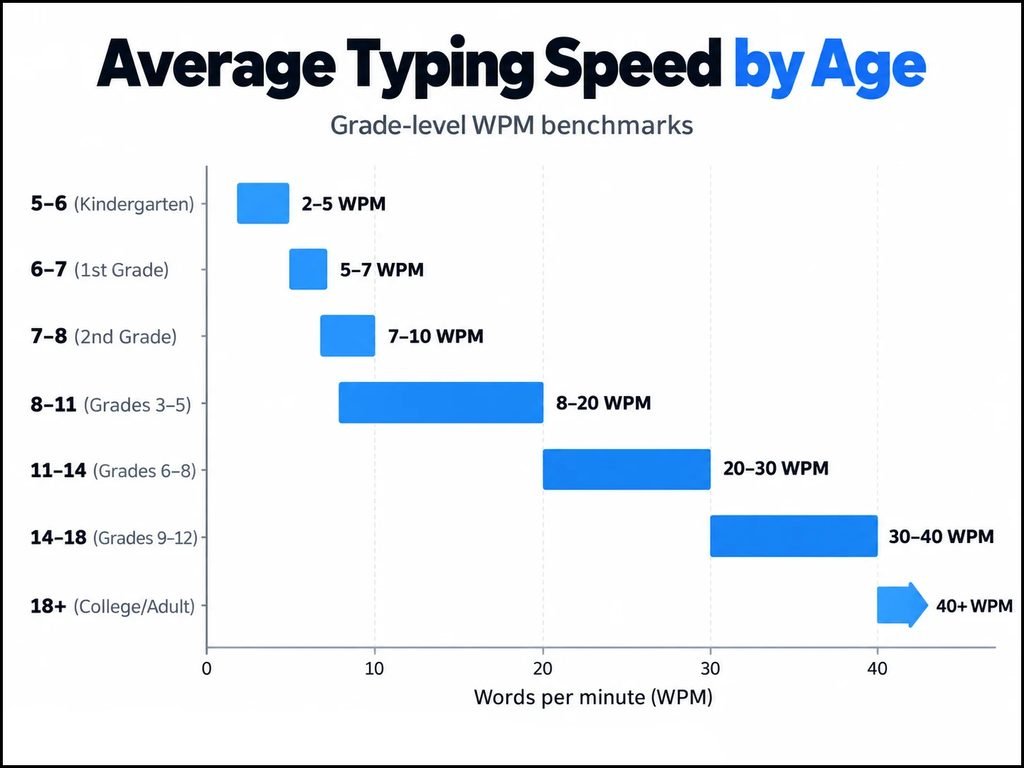
According to Typing.com’s grade-level typing speed guidelines, the following WPM ranges provide a useful reference for students and adults.
| Age (approx.) | School level | Typing speed |
|---|---|---|
| 5-6 years | Kindergarten | 2-5 WPM |
| 6-7 years | 1st Grade | 5-7 WPM |
| 7-8 years | 2nd Grade | 7-10 WPM |
| 8-11 years | Grades 3-5 | 8-20 WPM |
| 11-14 years | Grades 6-8 | 20-30 WPM |
| 14-18 years | Grades 9-12 | 30-40 WPM |
| 18+ years | College / Adult | 40+ WPM |
As the chart shows, a high school student might use 30-40 WPM as a general benchmark, while 40 WPM or higher is a common reference point for adult learners.
However, age alone doesn’t determine how fast someone can type. A 12-year-old who practices regularly may type faster than an adult who rarely uses a physical keyboard.
Accuracy matters just as much as speed. For example, typing at 50 WPM with frequent mistakes may be less useful than typing at 40 WPM with very few errors.
Use these figures to understand your current performance, not as strict limits on how fast you should be typing at a particular age.
What Is the Average Typing Speed for Kids?
Children usually develop typing skills gradually as they become more familiar with the keyboard. However, the average typing speed for kids depends more on their practice and experience than their age alone.
According to Typing.com’s grade-level guidelines, typing speed expectations generally increase as children progress through school.
Typing Speed for Kids by Age
Select an age group to see its typing speed benchmark.
*Ages are approximate US school ages. Grades 6–8 include students older than 12. These figures are educational guidance, not population averages.
Ages 5-7
At this age, most children are still learning where letters are located on the keyboard. Finding the correct keys is usually more important than typing quickly.
Educational benchmarks suggest approximately 2-7 WPM across kindergarten and first grade.
Encourage children to recognize letters, locate keys, and type short words accurately instead of pushing them to reach higher speeds.
Ages 8-10
Children between 8 and 10 often become more comfortable typing sentences and completing simple computer-based assignments.
Study suggest roughly 8-20 WPM for grades 3-5, which cover much of this age range. However, this isn’t a measured average specifically for 8-10-year-olds.
At this stage, practicing short paragraphs and developing consistent finger movements can help improve both speed and accuracy.
Ages 11-12
By ages 11-12, many students are typing longer assignments and using computers more frequently for schoolwork.
Middle-school benchmark is 20-30 WPM for grades 6-8, although some 11-year-olds may still fall within the elementary-school range.
If a child types around 25 WPM with good accuracy, they’re making progress toward this middle-school benchmark.
The important thing is to focus on steady improvement rather than comparing every child against a fixed WPM target.
What Is the Average Typing Speed for Adults?
The average typing speed for adults isn’t a single fixed number. It varies depending on typing experience, profession, and how frequently someone uses a keyboard.
A 2018 study by Aalto University and the University of Cambridge analyzed typing performance from 168,960 volunteers and found an average of approximately 52 WPM.
However, the participants had an average age of 24.5 years, with 75% between ages 11 and 30. This means the result cannot represent every adult age group equally.
Another study published in The BMJ in 2022 tested 2,690 healthcare workers in the Netherlands and recorded an average corrected typing speed of 60.1 WPM.
Interestingly, participants who had previously completed a typing course performed more than 20% faster, on average, than those without such training.
However, the study was observational, so it doesn’t prove that the course alone caused the difference.
These findings suggest that keyboarding experience and training are important factors when evaluating adult typing performance.
Does Typing Speed Decrease With Age?
Typing speed can decrease with age, but getting older doesn’t automatically mean you’ll become a slower typist.
Your experience, typing technique, and ability to anticipate upcoming words can influence how well you maintain your speed.
A 2022 study published in The BMJ examined 2,690 healthcare workers and found that typing speed was significantly lower in older age groups.
Interestingly, a 1984 study by psychologist Timothy Salthouse found a different pattern among skilled typists aged 19-72.
Although older participants had slower finger-tapping and reaction times, they maintained typing speeds comparable to younger participants.
Researchers suggested that experienced older typists compensated by preparing upcoming keystrokes further in advance.
A later 1993 study on age-related typing performance provided further evidence that skilled older typists could compensate for age-related changes by preparing their movements earlier.
What Is Considered a Good Typing Speed?
A good typing speed depends on how efficiently you can complete everyday tasks.
While there’s no universal standard for classifying typing ability, the following WPM ranges can help you understand your current performance.
| Typing Speed | Performance Level |
|---|---|
| Below 20 WPM | Beginner |
| 20–39 WPM | Developing |
| 40–59 WPM | Comfortable |
| 60–79 WPM | Fast |
| 80–99 WPM | Very fast |
| 100+ WPM | Exceptional |
These are general descriptive categories, not scientifically established classifications or age-specific population averages.
For everyday activities like writing emails, searching online, and completing school assignments, 40-60 WPM can be a practical target.
Jobs involving frequent typing may benefit from higher speeds, depending on their specific requirements.
However, your WPM score can change depending on the typing test you take.
A short test containing familiar words may produce a higher result than a longer passage with punctuation, numbers, and unfamiliar vocabulary.
For a meaningful comparison, use the same test duration and difficulty level whenever you measure your performance.
Conclusion
The average typing speed by age provides a useful reference, but there isn’t one universal WPM score that applies to everyone in the same age group.
Educational benchmarks can help students understand expected typing performance, while research shows that adult typing speeds vary with experience, training, and other factors.
Instead of worrying about whether you’re faster or slower than others your age, take a typing test to measure your current WPM and accuracy. Use that result as your starting point and focus on making steady progress.
Ultimately, a good typing speed is one that allows you to type accurately, comfortably, and efficiently for your everyday needs.
